skip to main |
skip to sidebar
Despite the fact that I work in London, i don't often get to see very much of it as I am dashing about to meetings and appointments. So yesterday was a real treat as I got to spend some quality time in the capital.
I started off at the Barbican where I saw the exhibition about the architect and designer Le Corbusier. I first went to the Barbican 13 years ago where I saw an exhibition of the photographer Don McCullin's work. I love the building, such a striking piece of design from the 1960's but very easy to get lost in.
I really enjoyed the exhibition but I found it a little bit too much for someone who does not know a huge amount about Le Corbusier. What I did enjoy was the bits of film that he made showing his vision and gave you a glimpse at what his early life in Paris may have been like. I was surprised about what I did know and how much of the furniture I recognised. I also enjoyed more his earlier work, which was more simple and had a youthful promise to it. Some of his later work seemed to be very grand and I couldn't identify with this quite as much. Le Corbusier was a very intelligent young man working on his first house at just 18 years old and his inspiration to the world of architecture and design continues through to today.
After lunch I visited Persephone books which I have been waiting to go to for sometime.
 I first heard about Persephone books from my good friend over at Cuppa Tea and Cake and a few weeks ago I was given one, 'A Very Great Profession' by Nicola Beauman, as a present. I love the idea behind Persephone, it was set up to publish books by and about women that were not readily available from other publishers. What makes them extra special is that each is printed with a plain grey cover, but inside is a wonderfully bright end-paper that has been chosen to match the book.
I was in there for sometime as I couldn't decide which book to choose. After much deliberating I settled on 'The Wise Virgins' by Leonard Woolf. He wrote it around the time that he was marrying Virginia Woolf in 1912-1913 and as I am up to 1908 in my Virginia Woolf read (see my other blog here) I thought I might be a good book to read as a break from Virginia Woolf.
Luckily I had my book bag with me so was able to get it home without it getting scuffed in my bag. All in all a rather fun day out

 On Tuesday 14th April I went to see Handel’s Messiah at Westminster Abbey. The performance marked the 250th anniversary of Handel’s death and poignantly it was performed in the place in which he is buried.
It is the first time that I have seen the work performed in it’s entirety. I took part in a Messiah workshop last year with the choral society that I sing with. We spent the day rehearsing the piece and then performed it to an audience of friends and family in the evening. It was great fun and also my first attempt at a solo. Singing is something that I have always done, but only started doing it again recently after a break of five years.
My Great-Grandmother sang all her life, right into her 70’s and my Grandfather also sang and played the organ for many years. I have programmes of Messiah concerts that my Great-Grandmother took part in dating back to 1917 so it is exciting for me to watch or take part in something that she took part in over 80 years ago.

Westminster Abbey is a wonderful place to have a concert, the sound just carries right up into the roof. I haven’t been there since I was a child so we took the opportunity to have a wander round in the interval. I am amazed at how a the abbey was ever built. It is huge and the craftsmanship that would have gone into it, and the time it would have taken is amazing!
The choir sounded superb with really beautiful treble voices and the soloists were really good too. I particularly enjoyed the Tenor soloist, Paul Agnew. He had a very clear voice and his articulation and expressions really added to the atmosphere of the evening. He is going to be performing at Covent Garden this year in Acis and Galatea. At my last concert with the choral society we sang a couple of pieces from Acis and Galatea so I would like to see it being sung professionally and would also love to hear Paul Agnew sing again.
My mum asked me to bring my score with me so that she could follow the piece. It is interesting how differently people hear music and I think she got more out of the piece by following the score rather than being a passive listener. We have decided to try to attend the Messiah sing along at the Albert Hall in November. Whilst some people think that Messiah should not be performed on a larger scale, we both think that singing the Hallelujah chorus in the Albert Hall with several hundred other people would be quite an experience!

A couple of weeks ago I made my annual trip to Dunwich for fish and chips at The Flora Tea rooms and a walk on the beach. Over the years mine and another family have met there on Mothering Sunday, but this year the numbers were somewhat depleted so it was just me and my mum.
Dunwich, or what is left of it as most of it has fallen into the sea, is typical of the Suffolk Coastline. A vast expanse of heath meets the shoreline at a dune of pebbles that cascade down towards the sea. We had great fun rummaging amongst the pebbles to look for hag stones which can be hung up together to keep witches away. If you are lucky, or spend a large amount of time looking, you can find pieces of amber mixed in amongst the stones.
We started off by having lunch at the tea rooms. It is a simple wooden shack and it serves large plates of fish and chips with pots of tea all on old fashioned green ceramic plates. In the very British tradition of “if the sun is shining make the most of it” we sat outside even though the air was a little nippy. 
After lunch we walked off our chips braving it over the dunes and into the wind. There is something very simple about Dunwich, next to the tea rooms are a few boats and dotted up the coast might be a few people fishing or walking, but other than that it is really empty.

Aside from the chips and the beautiful scenery the thing I enjoy about going to Dunwich is stopping at Westleton, the village before Dunwich, and visiting the second hand book shop. Set in a Methodist church, this is one of those quirky little finds. The books are piled up in bookcases or boxes, but all are labelled by type. A door out to the back office has a sign that says “Hit can with stick for attention” and sure enough if you do this the proprietor will come out and answer your questions and even offer you a cup of tea or coffee. I picked up a couple of 1940’s penguin classics to add to my ever-growing collection…

I have wanted to visit Sissinghurst Castle for a long time. I first heard the name when I began reading about Virginia Woolf and the Bloomsbury Group. It was not until sometime later though that I realised that it had a fabulous garden and even then I was not really sure what it would be like. Despite only being a 20 minute drive down the road from where I live and being a member of the National Trust I have only just been to visit it this weekend.
My mum arrived at my house on Saturday morning in time for a quick coffee before we set off to find the castle. The drive down through the Kent countryside is very relaxing with stunning views of the Kent Downs. Sissinghurst village itself is very pretty, we were drawn to the antique shop but resisted and drove down the road to the castle that is just off the main road that runs through the village. It is a very narrow road with 6ft high hedges running along both sides so you have no idea what the castle looks like and it is only once you have parked the car and walked through a small wood that you actually see it.
What I hadn’t appreciated is that the castle is in fact a ruin of a once grand castle. When you first walk up to the castle you can see the tower poking up and you just assume that the rest of the castle is hidden by the building in front of you. It is only when you get through the main gate that you see that the tower is in fact standing on it’s own and there is no castle to be seen!

It has taken many different forms over the hundreds of years that it has been standing and there is quite a good summary here.
We started off by having lunch at the restaurant that is housed in a refurbished barn. The food was delicious, I loved the home made chutney that is made from vegetables that are grown in the garden. They are currently working on producing more home grown food at the site which is great. The windows of the restaurant, large wooden frames that blend into the scenery, allow you to enjoy the pretty view whilst staying in the warm as it was a bit overcast at this point.

I assured Mum that by the time we had finished our lunch the weather would have improved and sure enough, when we set off towards the garden the sun had come out.
For me, the real interest in the garden is the last family of occupants, Vita Sackville-West and her husband Harold Nicholson. I am fascinated by the Bloomsbury set and I have read about Sissinghurst Castle in Virgina Woolf’s diaries. The garden was developed by Vita and Harold and they were inspired by the gardener Gertrude Jekyll. It is set out into lots of different areas, each with its own theme and distinct planting scheme. Some areas are very formal, whilst others are much wilder and flowing. Moving around the garden you get a feel for the different themes that they were trying to achieve in the garden, but this becomes much clearer when you see the views from the tower. You can very clearly see the different areas of the garden and the blocks of colour really stand out. The borders around the edge of the first part of the garden before the tower are absolutely full of plants in contrast to the delicate climbing roses on the wall of the library.

The grass is immaculate and I felt really bad walking across it and wanted to pick up the stray leaf that had blown onto it. The tower itself is a wonderful part of the estate. Vita had her writing room up here and peering in through the door you can see a room full of books as well as her writing desk. The space where she wrote is surrounded by all sorts of little trinkets and large picture of her friend Virginia Woolf. Although the weather had improved there was still quite a breeze at the top of the tower, but what a place to go when you are lacking inspiration.

Having come down from the tower we wandered through into the wilder part of the garden. The grass has been allowed to grow long and there are bee hives dotted about amongst the fruit trees. The original moat of the castle still exists and I think it would be wonderful to row a boat along it on a cool summer evening.

The pavilion at the corner of the garden was built in memory of Harold Nicholson by his sons in 1969 following his death in 1968. From the garden it doesn’t look very impressive, but from the footpath on the edge of the garden you can take a peek inside. Following the moat round you are brought to the more formal area of the garden. This pot here really needed to be taken with a person in the picture, as it was huge, about 4ft tall!

There is certainly plenty of room here for oversized pots without them detracting from the rest of the garden. Winding back down through we found ourselves in the hot garden which also has a cottage in it (which you can see from the top of the tower).
I would be quite happy with a house and garden this size and it really demonstrates how big the estate is that this is just one small part of it. I loved the colour of this pot and the contrast with the orange and green of Osteospermum in it.

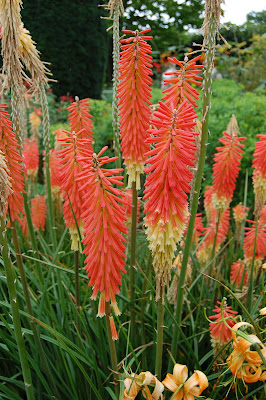
The garden really does live up to it’s name as all of the plants in it are deep fiery red and orange colours with touches of pink and yellow too. I would love to see this garden in the winter to see if it still has that warm feeling. We headed back towards the moat and I was pleased to find some borders that were more on my scale. These borders ran the length of the wall and I could see the remains of the alliums that had been planted there. It is about the same width as my borders and I think I will be planting some of this in my garden.

We finished up in the white garden where we spotted this perfectly coloured little white butterfly. The seperation of the gardens by colour really helps to make distinct areas, but the style of planting is also very different. In the white garden the planting is quite informal but each bed is divided up by a very rigid box hedge.

I felt that the garden was almost too big, I was ready for a cup of tea and piece of cake at the restaurant by the time we had walked around. It is definitely one to visit again and again so that you can see how it changes throughout the year and really get to know the different gardens. I don’t know what it would be like to live with. Obviously you would have to have a whole team of people maintaining the site, but I think I would prefer something more on the scale of Charleston. You can very easily get lost at Sissinghurst, and you could spend your whole day not seeing anyone if you wandered off to a quiet part of the garden. I did however get lots of inspiration from the garden and there are several things that I would like to try in my own garden, even if it is on a smaller scale.

One of the unexpected highlights of the day for me was in an exhibition about the history of the castle that we popped into just as we were leaving. In a room about Vita’s friendship with Virginia Woolf there was on display THE “Hogarth Press” (pictured above) that Virginia and Leonard Woolf had used to print some of their early books at Hogarth House in London. Virginia had given it to Vita as a present in 1930. I had seen the printing press when we went into the room, but it was only when I read the information on the wall that it all became clear. I hadn’t quite appreciated that Virginia and Leonard had printed books by hand, page by page, setting the type for each page by hand.
I really enjoyed my day out at Sissinghurst and as I have just renewed my National Trust membership I will be visiting it again soon


